Data migration in Engage refers to transferring your data as files via the Voyado FTPS.Transfers like this are done periodically, usually once per hour, but this can be adjusted per client and method according to your needs. If the Voyado FTP server is unresponsive, it’s up to the sender to re-attempt the transfer until it has been successfully received.
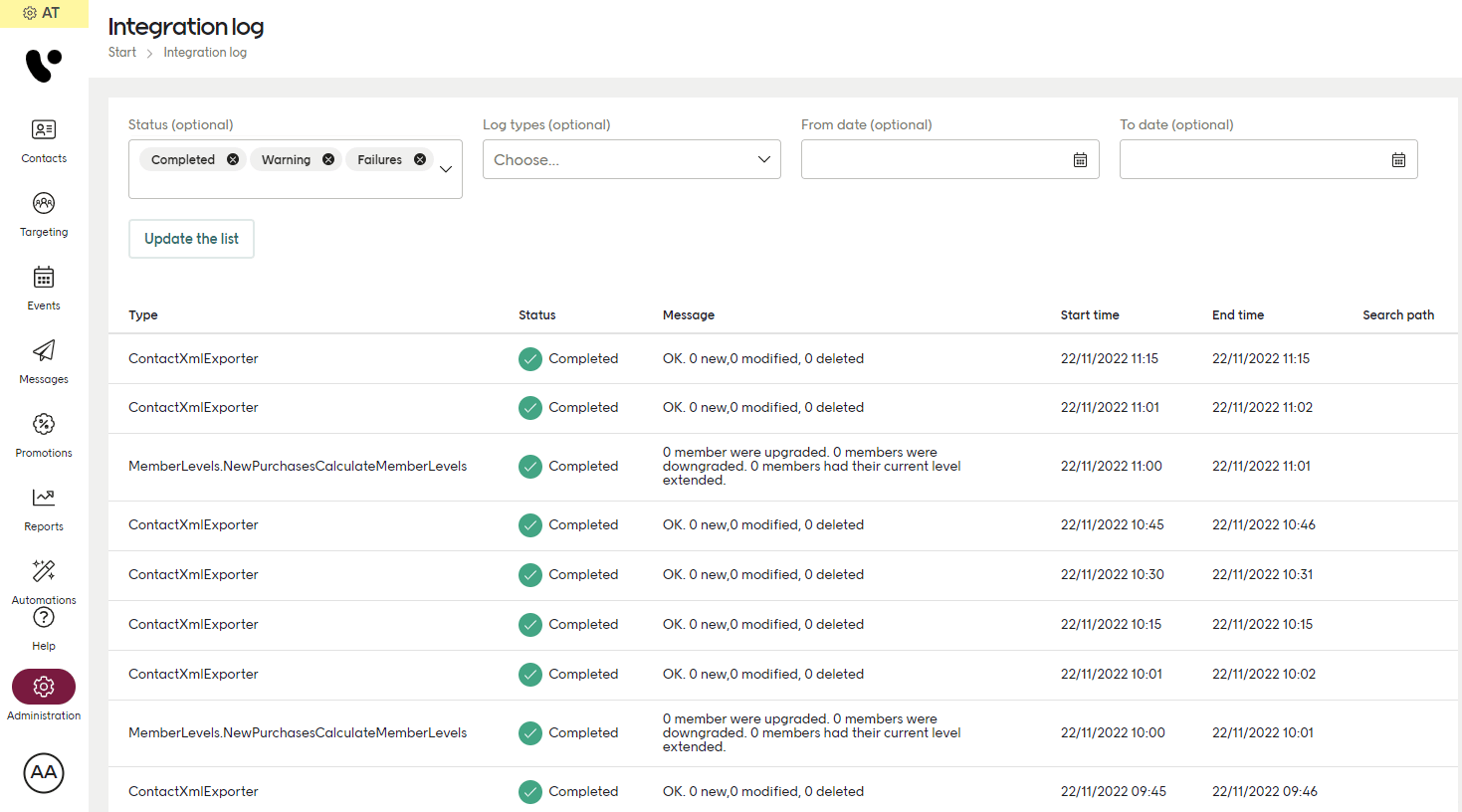
When the import batch job is triggered, Engage begins processing files and importing the transactions. Once a file is processed you will be able to see the status of the import on the Integration log (see image below). The processed file will then be deleted from the FTP folder.
Don’t exceed 20 000 contacts per file. This is not a hard limit but a strong recommendation, since large files can make the server slow and risk causing a timeout.Keep the number of contacts per file under 20 000.
The encoding of your CSV and XML files must be UTF-8.For XML files, follow the scheme specified per import type (Contacts import, Transactions import). It is also good practice (although not mandatory) to follow the XML-syntax provided per object. When these field names are followed, no client specific XSLT transformation needs to be done on the Engage side of the integrations.
The required date format is ISO 8601 with a time zone designator, for example: 2021-01-26T15:10:17+01:00.Date of birth (for example on a Contacts migration) is allowed to also use the simpler: YYYY-MM-DD.
Your CSV should use semicolon (;) as a delimiter to separate the fields. This also means that you can’t use ; anywhere in a value string.The order of the fields in a CSV does not matter.Some characters can break a file import and might need to be escaped before import. For example, the double quote character (”). A double quote can be a part of a product name or description, since ” is the symbol used for “inch”: Samsung 42 ” TV. Fix this by adding a backslash before every ” in your CSV (this is called “escaping” the character). A search-and-replace is probably the best way to do this. The example above will then be Samsung 42 \” TV .